GILSON JORGE
Photo: University of Kansas / Courtesy
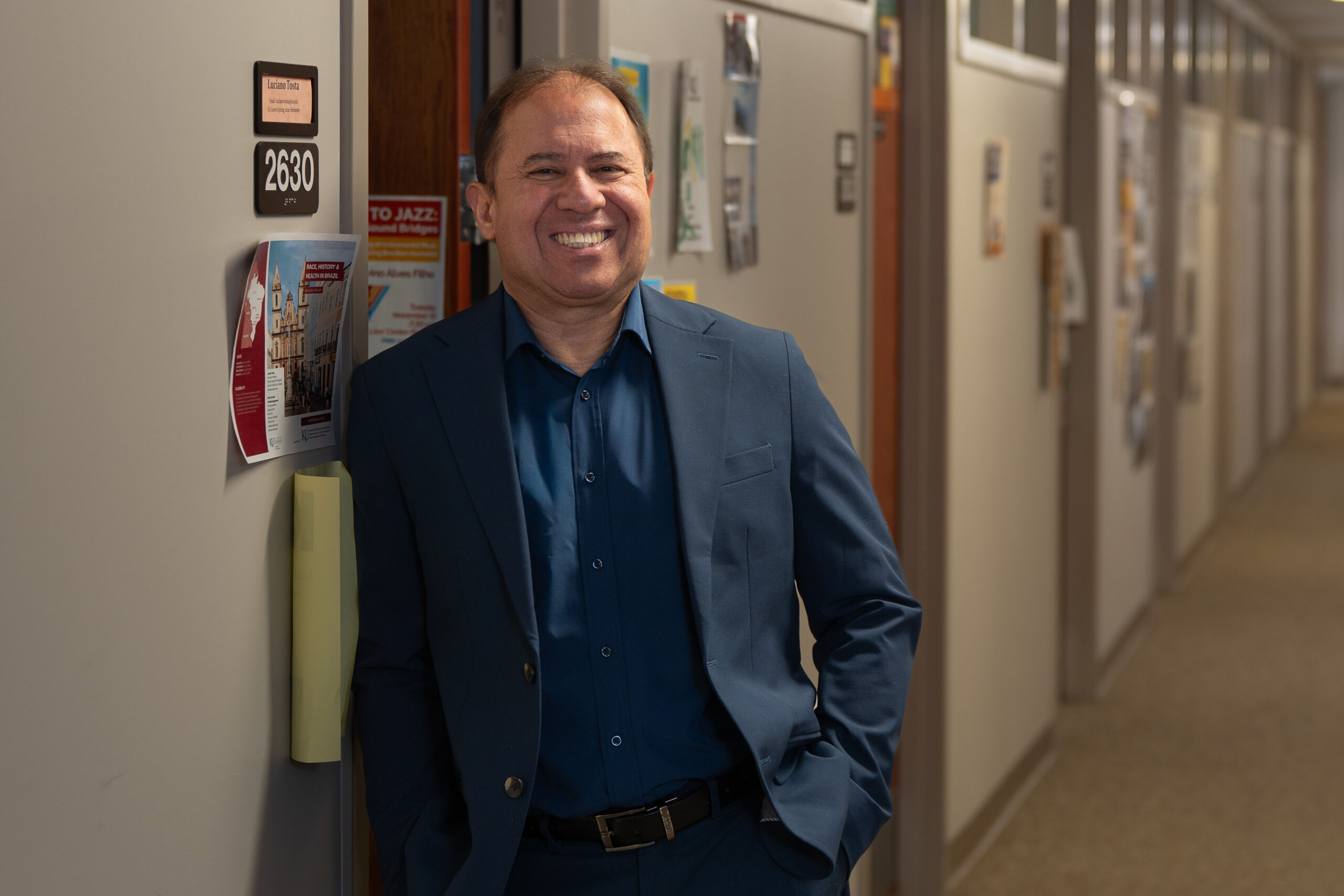
In early July, the Federal University of Bahia’s Federação Teaching Pavilion in Salvador hosted the 18th Congress of the Brazilian Studies Association (Brasa), which brings together international scholars dedicated to studying Brazil in the fields of culture and the social sciences. Following the event, Salvador native Antonio Luciano Tosta became Brasa’s executive director. He is also director of the Center for Global and International Studies at the University of Kansas in the United States. Tosta holds a PhD in Comparative Literature from Brown University and teaching and bachelor’s degrees in Letters from the Federal University of Bahia. In this interview, he discusses how the association operates and his plans for the term that began immediately after the congress.
How did the Brazilian Studies Association come into being, and what are its objectives?
Brasa was founded in 1992 during the congress of the Latin American Studies Association, or Lasa, held in Los Angeles, California. Around 40 scholars attended that meeting and decided to create an association to promote Brazilian studies and strengthen connections between those who study Brazil and those who study the rest of Latin America. Brasa’s first conference was held in March 1994 in Atlanta, during the Lasa conference.
The conference traditionally takes place every two years, alternating between Brazil and the United States. It has also been held twice at King’s College, University of Cambridge, in England. In Brazil, it was first held in Recife, Pernambuco, in 2000. It was subsequently held at PUC in Rio de Janeiro in 2004 and again in 2018. In 2010, it took place in Brasília. Salvador is therefore the second city in Brazil’s Northeast to host the conference.
Last year, Brasa presented an award to an article by Mariana Jeffreys about the 60th anniversary of the military coup. Which topics concerning Brazil attract the greatest interest among the international academic community associated with Brasa? Culture? Politics?
Politics is certainly one of the areas that interests Brasa’s members. Historically, cultural studies and the humanities predominated in conference presentations and in members’ research. More recently, however, there has been significant growth in the presence of the social sciences. The topics are extremely varied. We want to continue broadening the association’s scope and to include the natural sciences as well.
It is also important to note that Brasa has increasingly become a shared space for Brazilians and non-Brazilians engaged not only in understanding Brazil, but also in learning from and with Brazil about universal issues. As Professor Livio Sansone of the Federal University of Bahia says, Brasa has become much more Brazilian.
Brasa provides scholarships for Brazilian university students at foreign institutions. How does the program work?
Brasa currently presents awards for the two best academic articles or book chapters in the humanities or social sciences. We also recognize two books about Brazil published in English that have made significant contributions to the field of Brazilian studies: Isadora Moura Mota’s Freedom’s Horizon: Black Abolitionism in Nineteenth-Century Braziland David C. Thompson’s Where the Sun Rises Square: Mass Incarceration and the Binds of Reform in Brazil.
We also offer a scholarship for graduate students to conduct research in Brazil or the United States. The aim is to encourage exchanges between Brazilian students living in Brazil and scholars in the United States, as well as between students from the United States and researchers and universities in Brazil, so that they can develop projects focusing on Brazil. We recommend that students combine this scholarship with other sources of funding. In addition, we offer an award to help graduate students attend our conferences.
What were the principal discussions at the Brasa Congress in Salvador?
The 2026 Congress in Salvador had the largest number of participants in the association’s history, with 1,600 registrations. To give you an idea, the second largest was held in San Diego in 2024 and had 800 participants. I believe this demonstrates both the association’s growth and Salvador’s appeal as a destination for the academic community.
The event, which was Brasa’s 18th congress, brought together researchers, activists, writers, artists, and students from around the world in dialogue with Brazilians. In addition to academic presentations covering a wide range of topics, we held meetings between writers and their readers, special cultural sessions, and presentations by representatives of institutions such as the Bahia Academy of Letters.
You have just become the first person from Bahia to lead Brasa. What are your plans for your term?
The association is still transitioning from Tulane University to the University of Kansas. It is important to explain that Brasa has an executive committee whose membership changes every two years, when a new vice president is also elected. The vice president automatically becomes president two years later.
The University of Kansas, where I teach and serve as director of the Center for Global and International Studies, will be responsible for administering the association, but all planning is conducted jointly with the executive committee. Because the conference has only just concluded, we do not yet have a fully developed plan.
One possibility under consideration, for example, is creating an academic journal that would serve the community and meet the growing demand for publications in Brazilian studies. We have also discussed expanding our congress to new locations, including countries in Europe and Africa.
Brazil and the United States have experienced growing political estrangement since the impeachment of Dilma Rousseff and the subsequent Lava Jato investigation, both of which allegedly involved influence from Washington. After neglecting its relationship with Latin America, the United States is again exerting influence in the region by supporting local right-wing and far-right leaders. How do you view the immediate future of Brazil–United States relations in light of this year’s elections in both countries?
I would say that the relationship between Brazil and the United States will remain important, as it always has been, but without the sense of stability that once characterized it. This year, both countries will hold highly polarized elections, increasing tensions at a time when new tariffs are already being imposed on Brazilian products and there is the possibility of Washington interfering in our politics.
When the United States raises tariffs, it directly affects Brazilian companies, jobs, and exports. At the same time, Brazil and the United States remain major commercial and diplomatic partners. I therefore believe that neither country has any genuine interest in breaking with the other. I do not think they will stop negotiating, even if they are publicly at odds.
The elections will play an important role because they will determine the nature of that relationship. The 2026 midterm elections here in the United States will be a test for the American president. They will affect control of Congress and, consequently, his ability to pass legislation, advance his agenda, and avoid intensive public scrutiny by Congress itself.
If a more protectionist and ideological orientation prevails in Washington, we may see additional tariffs, for example. Ideologically, dialogue may become easier or more difficult depending on who wins in Brazil. But it will continue in one form or another. Under any of these scenarios, Brazil will need considerable wisdom to defend its interests without allowing itself to be manipulated.
What does your research on hunger involve?
I participate in an international, interdisciplinary research group on food security. Because I am a cultural studies scholar who works with representations, my research examines how hunger, or food insecurity, appears in novels, films, and photographs.
In April of this year, we organized an international and interdisciplinary conference on food insecurity at the University of Kansas in partnership with the Federal University of Rio Grande do Norte and the Federal University of Sergipe. At the Brasa Congress, I presented a paper on Garapa, a 2009 documentary directed by José Padilha. I discussed both its cinematography and how documentary filmmaking more generally can contribute to combating food insecurity.
I intend to publish articles on the subject, but I also want to expand the project into an interdisciplinary book tracing the development of representations of hunger in Brazilian art. The works would also be examined in relation to the context of food insecurity in Brazil at the time they were published or produced.
Could you name some of the works?
From a historical perspective, the project begins with José Américo de Almeida’s novel A Bagaceira, whose background includes sugarcane plantations and migration. It then considers Graciliano Ramos’s Vidas secas; Carolina Maria de Jesus’s Quarto de despejo: diário de uma favelada; and José Lins do Rego’s Menino de engenho.
More recent works include Torto arado, by Bahia’s own Itamar Vieira Junior, and Garapa, which I discussed at the congress. There is also Cristiano Burlan’s 2015 film Fome; Camilo Tavares’s documentary Histórias da fome no Brasil; Walter Moreira Salles’s Central do Brasil; and Sebastião Salgado’s photographs in the Trabalhadores series.