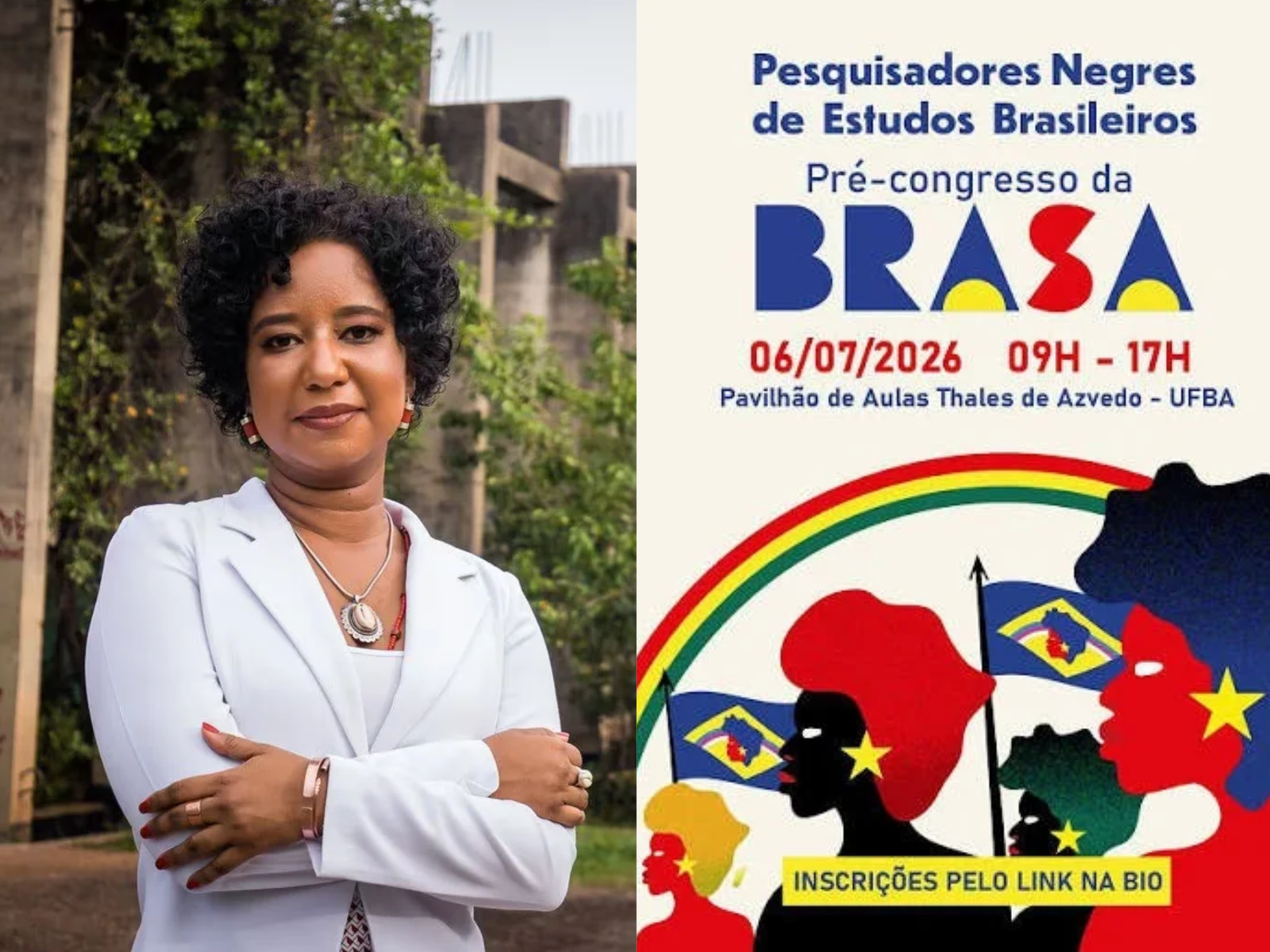
Ana Flávia Magalhães Pinto*
In 2026, we mark 55 years since November 20 was established as the National Day of Black Consciousness. It is the most significant civic commemoration in Brazil to have emerged from popular demands! Its creation demonstrates how the Black Movement became a political actor with broad social reach, even without conforming to preconceived models of what is commonly called a “mass movement”. From 1971—when the Grupo Palmares in Porto Alegre undertook its first initiatives—to the present, an ever-growing number of actions across the country have been sustained by a common purpose: confronting a framework of collective memory that reduces Black people to the image of enslaved persons as objects, undermining the possibility of recognizing the majority of the Brazilian population as genuine historical subjects, across territories and historical periods.
The result has been the public enactment of a historiographical agenda established by those who envisioned the reparative significance of commemorating November 20, 1695—the day Zumbi dos Palmares joined the ancestors, becoming a symbol of struggles for freedom and struggles waged in freedom. This choice directly challenges May 13, 1888, a commemorative date used by elites to symbolize freedom granted by the princess regent to an amorphous multitude, portrayed either as a decorative element or as a social problem. I deliberately use the expression “historiographical agenda” to emphasize that activist intellectuals within the Black Movement, whether or not they have recognized academic careers, have demanded, influenced, and carried out the rewriting of History. It is from this collective that the pathways leading to Law No. 10,639/2003, affirmative action policies in higher education, and several other ongoing antiracist transformations have emerged.
And this phenomenon is by no means confined to History as a discipline. Although studies of slavery continue to occupy considerable space in academic research, it is investigations of freedom, post-abolition societies, citizenship, antiracism, and intersectionality, pursued through interdisciplinary and transdisciplinary approaches, that have most strongly mobilized the intellectual production of Black scholars, whose presence in these spaces has grown considerably in recent decades. An epistemological renegotiation is taking shape and gaining momentum. It is therefore unsurprising that the effects of this strategic engagement by Black activist intellectuals have reached the Brazilian Studies Association (BRASA). In July of this year, building on connections developed during previous congresses, we held the workshop “Politics, Art, and Memory for Black Researchers” on the day preceding the official opening of the 18th BRASA Congress in Salvador, Bahia. Initially coordinated by Dr. Gladys Mitchell-Walthour (North Carolina Central University), Dr. Cloves Oliveira (Federal University of Bahia), Dr. Ana Flávia Magalhães Pinto (University of Brasília), Dr. Joshua K. Reason (San Francisco State University), and Dr. Giovani Rocha (Mahin Antiracist Consulting), the gathering gave rise to a network of Black Researchers in Brazilian Studies (Pesquisadores Negres em Estudos Brasileiros, PNEB). This process of collective self-recognition fosters new forms of connection that, in turn, are likely to transform how we understand our presence both within and beyond institutional settings.
Indeed, we experienced something similar earlier this November at the conference “The Next Century of Black Studies,” held at the Schomburg Center for Research in Black Culture. Thanks to the Amefrican engagement of Dr. Tanya Saunders (University of Maryland), we had opportunities within the program to draw attention to Afro-Brazilian experiences in Black Studies. During the panel “No Hay Estudios Negros Sin Afro-Latinoamerica,” we were able to advance a critical argument: it is not enough to include Brazil as an exotic subject or a racial laboratory. We must recognize, fund, and build a space in which Black Brazilian researchers occupy a central position as political subjects and producers of theories essential to global antiracist thought.
With a few minor adjustments, the questions raised there apply equally well here, especially in light of the significance of November 20: What do we stand to gain by overcoming the underrepresentation of Black researchers in Brazilian Studies? What questions would become priorities if we moved beyond debates over the myth of racial democracy as the primary reference point for comparative and transnational analyses? What recent advances have been made in Brazilian Studies across the Americas in recognizing the experiences of Brazil as the country with the largest Black population outside Africa, and who has been leading those advances?
While it is true that Lélia Gonzalez’s “political-cultural category of Amefricanity” (amefricanidade) has gained wider and more meaningful circulation both in Brazil and elsewhere across this expanded territory of ours, I believe that her concept of pretuguês—which illuminates how we reorganize our linguistic practices—is central to identifying ways to overcome the isolation of Black intellectual production in the language spoken in Brazil. The Portuguese-language barrier can no longer function as a geopolitical boundary of knowledge that separates Brazilian Studies from other fields concerned with the experiences of the Global South.
Despite persistent vulnerabilities, technological advances, when shaped by our own agency, have created promising opportunities to transform the conditions under which Black intellectual production from Brazil circulates. Beyond important initiatives to translate into English and Spanish the works we have succeeded in introducing into formal Brazilian curricula, we need to invest more energy in developing low-cost strategies aimed at building connections from an Amefrican perspective. This brings us closer to the horizon envisioned by Milton Santos, whose centenary we celebrate this year, when he spoke of another, possible globalization—possible because it expresses our capacity to confront globalization as both fable and perversity.
* Professor in the Department of History (HIS) and the Graduate Program in Human Rights and Citizenship (PPGDH) at the University of Brasília (UnB). Member of the Network of Black Historians, the team at Instituto Cultne, and the advisory boards of Instituto Commbne – Communication Based on Innovation, Race, and Ethnicity; Casa Sueli Carneiro; and Amma Psique e Negritude. Founding member of the Working Group on Community Archives of the Latin American Association of Archives (GTAC/ALA). Author of Escritos de Liberdade: literatos negros, racismo e cidadania no Brasil oitocentista (EdUnicamp, 2019) and Imprensa Negra no Brasil do Século XIX (Selo Negro, 2010). Email: anaflaviahist@gmail.com.